School Retro: A Playful Display Font for Handmade Brands
If you’ve ever spent hours tweaking a label design only to realize the font feels too stiff—or too trendy—then School Retro might be the quiet game-changer your shop needs. As a maker who designs printable planners, hand-stamped tags, and SVG bundles for Cricut and Silhouette users, I don’t reach for display fonts lightly. They need to hold up at 12pt on a tea towel tag *and* shine at 200pt on a farmhouse welcome sign. School Retro does both—not by trying to be everything, but by owning its joyful, nostalgic voice with clarity and craft.
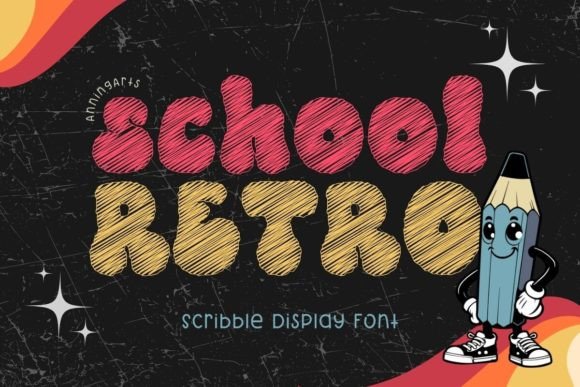
School Retro is a scribble-style display font that balances spontaneity and structure. Think chalkboard doodles reimagined with clean vector precision: slightly uneven baselines, soft rounded terminals, subtle bounce in the ascenders, and just enough retro flair—like a well-loved 1980s classroom poster remastered for today’s small-batch aesthetic. It’s not overly distressed or cartoonish; it’s warm, legible, and quietly confident. That balance makes it unusually versatile across physical and digital product lines.
Where School Retro Shines in Real Craft Projects
This isn’t a font you’ll use for body text—but it’s perfect where personality matters most. On candle labels? Yes—especially for “Back to School” seasonal scents like “Pencil Shavings & Paper”, “Lunchbox Love”, or “Library Dust”. The letterforms read cleanly even at 16–18pt on a 2” kraft sticker, and the subtle groove keeps it from feeling juvenile. For greeting cards and invitations, School Retro adds instant charm without sacrificing professionalism—try it for the headline on a birthday invite (“Let’s Make This One Unforgettable!”) paired with a crisp sans serif for details.
Wall art and printable decor benefit deeply from its rhythm. I used it last month for a set of “First Day of Fall” classroom-style posters—each one features a single phrase like “Cozy Vibes Only” or “Hot Cocoa Approved”—and customers specifically mentioned how “easy on the eyes” the typography felt, even though it’s decorative. That’s School Retro’s quiet superpower: expressive, yet never exhausting to read.
For wedding stationery, it brings unexpected warmth to rustic or modern-minimalist suites. Imagine “Mr. & Mrs.” in School Retro above a delicate script name, printed on seeded paper. Or use it for a welcome board at a barn venue—“Welcome to Our Story” feels heartfelt, not hokey. And for boutique product tags? It elevates handmade soap, bath salts, or small-batch jams with an artisanal, story-driven tone that resonates with shoppers who value intention over polish.
Practical Tips for Cutting, Printing, and Pairing
If you cut with Cricut Design Space or Silhouette Studio, test School Retro at your smallest intended size *before* finalizing a project. Its open counters and moderate stroke contrast make it reliably cuttable down to 14pt on vinyl and cardstock—just avoid ultra-thin shadow layers or intricate outlines unless you’re using high-resolution print-and-cut. For small stickers (under 1.5”), stick to bold phrases—“Yes Please”, “Made With Love”, or initials—rather than full sentences.
Pairing is intuitive. Try School Retro with a friendly sans serif like Montserrat or Poppins for contrast that feels balanced, not jarring. For a handwritten touch, layer it with a relaxed script—think a flowing signature font for names or accents, while School Retro anchors headlines and titles. Avoid pairing it with other highly textured or distressed fonts; its charm lies in its controlled playfulness, not chaos.
The font includes standard OpenType features—ligatures for natural “fi”, “fl”, and “ff” connections, plus stylistic alternates for select letters (like a swash “g” or double-loop “y”). These aren’t gimmicks—they’re subtle upgrades that help your designs feel intentional and polished. It’s delivered in OTF and TTF formats, fully compatible with Adobe apps, Canva, Cricut, Silhouette, and most major design tools. While it supports basic Latin characters (A–Z, numerals, common punctuation), it’s not built for multilingual packaging—so keep that in mind if you sell globally.
Licensing That Supports Your Business
Here’s what matters most when you’re selling physical goods or digital downloads: School Retro comes with an extended commercial license. That means you can use it freely on product labels, packaging, SVG files for cutting machines, printable templates, social media graphics for your shop, and even embroidered designs on tote bags or tees—no per-unit fees, no hidden restrictions. Just credit isn’t required (though it’s always appreciated!). If you’re creating client work—say, designing a boutique’s seasonal signage or a school fundraiser banner—you’re covered there too. Just don’t resell the font file itself or claim it as your own design asset.
For me, School Retro has become my go-to for anything that needs to say “thoughtful, fun, and made with care”—without shouting. It strengthens brand consistency across product lines: same font on a sticker, a digital planner cover, and a wall quote creates visual continuity that customers subconsciously recognize. That kind of cohesion builds trust, especially in crowded markets like Etsy or Instagram shops where first impressions happen in under three seconds.
Whether you’re printing vintage-inspired bookmarks for Teachers’ Day, designing a “Welcome Back” mug series, or building a cohesive back-to-school printable bundle, School Retro doesn’t distract—it invites. It says “this was chosen, not just dropped in.” And in handmade commerce, that tiny distinction often translates directly into cart clicks, repeat buyers, and word-of-mouth shares.